Home/Bats
Bat Removal in Shreveport
Bats are the most legally constrained animal in this trade. Getting the timing wrong is not just inhumane, it is often illegal.
Tall old masonry and large uninterrupted attic volumes in the Highland and downtown fringe give bats the kind of roost they settle into for years. A colony in a building of that age is rarely in one tidy place, which is why an emergence count at dusk tells you more than an hour spent in the attic.
Bats in Caddo Parish: who does what
The City of Shreveport publishes a short list of what it does not do, and it is unusually blunt: it does not pick up stray animals, does not spray for mosquitoes and does not supply rat poison. All of it goes to Caddo Parish Animal Services instead, and Caddo handles dogs and cats. Nothing in either remit covers an animal that has moved into a roof, so a squirrel in the eaves is a private expense from the first phone call.
For identifying an animal or damage before anyone is paid to look, the LSU AgCenter, Caddo Parish office is at 2408 East 70th Street, Shreveport, LA 71105 (office page).
What Louisiana law says about bats
Under Louisiana’s operator rules bats may only be excluded, or captured and relocated; killing them is prohibited. LDWF also warns that entangling migratory birds in netting is a federal offence, which matters when a roofline is being sealed. Eleven bat species have been identified in the state. All Louisiana rules →
Sources: Louisiana Administrative Code Title 76 (wildlife and fisheries); LDWF: Bats in Homes; Louisiana Department of Health: rabies annual report 2023; City of Shreveport, Animal/Pest Nuisance. Checked October 2026.
Signs, and why they matter
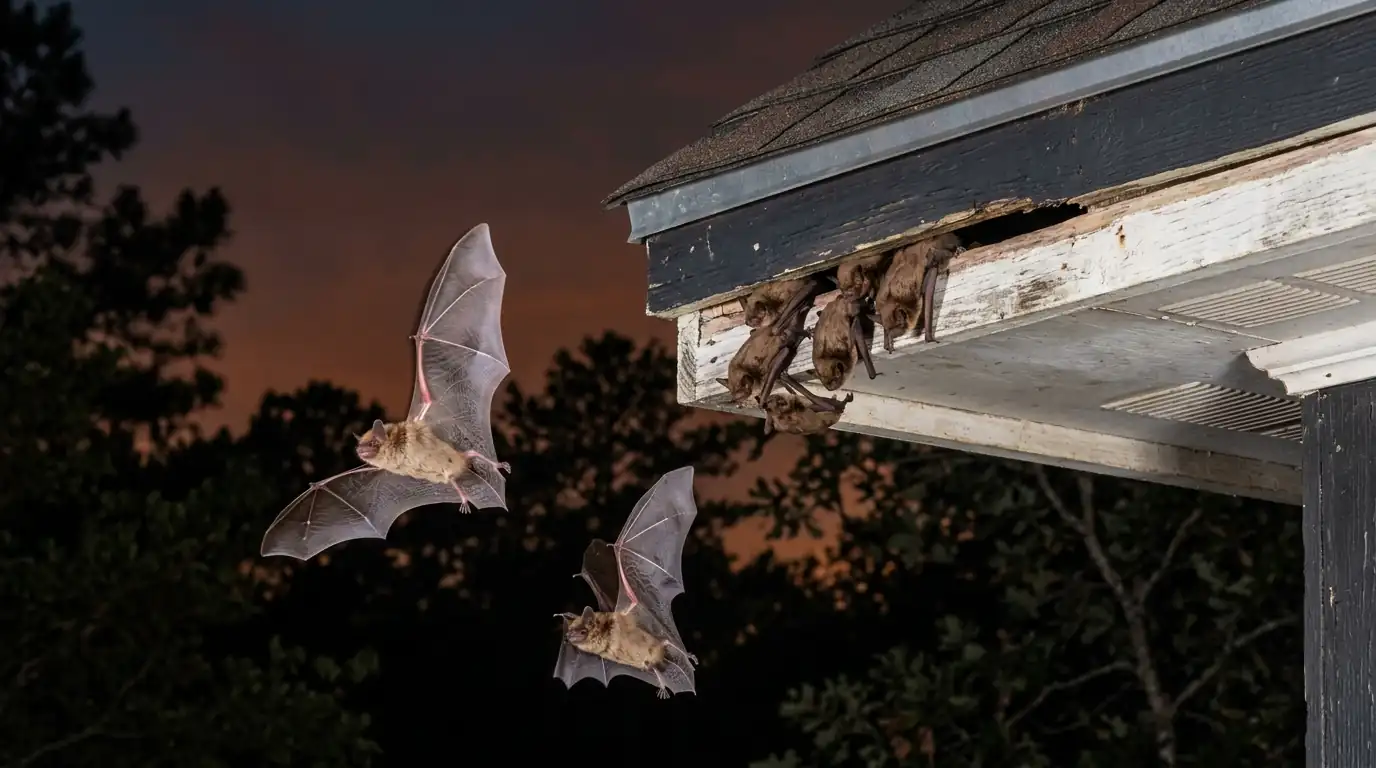
- Bats seen leaving the roofline, a gable end or a chimney around sunset
- Squeaking or rustling from a wall cavity or attic, worst on hot evenings
- A sharp ammonia smell: accumulated guano and urine
- Rabies: any direct contact, or a bat found in a room where someone was asleep, needs a call to your health department
- Histoplasmosis, a lung infection from fungal spores in accumulated guano
How removal works
Bats are never trapped or killed. A licensed operator fits one-way valves at the active exits so bats can leave but cannot re-enter, seals every other gap first, then removes the valves once the roost is empty. Guano removal and attic decontamination usually follow.
Bat questions
How much does bat removal cost in Shreveport?
$400 – $600 small colony · $500 – $1,200 typical · $5,000 – $8,500 for a large colony, depending on access and whether young are present. After a long stay in an attic the cleanup is often the bigger bill (attic restoration).
Is there a wrong time of year to deal with bats?
Exclusion is restricted during maternity season, when pups cannot yet fly. Sealing a roost then traps them inside to die. The dates differ by state: see the Louisiana law page.
Request a quote
We read every request and pass it to a licensed wildlife operator covering Shreveport where one is available. We are still building our list of operators here, so we cannot promise one is available or say how quickly they will respond.